The Country's Memory: Jimi Hendrix, Strange Fruit, and American Music at 250
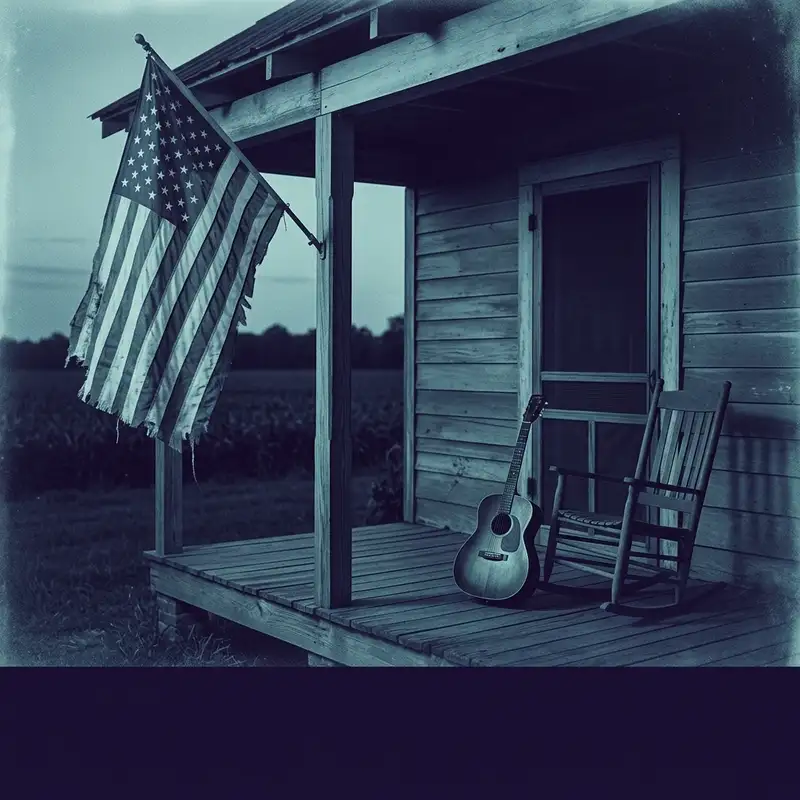
Download MP3That is the national anthem.
Jimi Hendrix played it on the
morning of August 18th, 1969,
at the close of Woodstock to a
field that had mostly gone home.
He kept every note of the melody
exactly where it belonged.
Around the notes, he let in the war.
The feedback you just heard is a guitar
imitating rockets and sirens over a
country that was burning villages in
Vietnam and burning bases in the South.
He didn't deface the song.
He played you what was
running underneath it.
Every Fourth of July, the country
sings a song about itself.
This is an episode about
the songs that sang back
This is Groundwater.
I'm Thomas Stubbs.
A special one outside the usual run.
This year, the country turns 250.
It was declared in Philadelphia in 1776
on a document that said all men are
created equal, written in part by men who
owned the people who worked their fields.
The show usually moves the way the
book it comes from moves, one chapter
at a time, New Orleans, north to
Chicago, and out across the water.
We'll be back on the map next time.
This one steps back and
asks a different question.
250 years in, what has the music been for?
The answer this episode makes is that the
music has been the country's memory, the
part of the record that didn't get edited.
Act one: the first account.
Start with the founding and
with what the founding left out.
The men who wrote the
document could write.
They left a record, declarations,
constitutions, letters,
ledgers down to the dollar.
The people they owned were
forbidden by law across most of the
South to learn to read or write.
Those people left a record too.
They sang it.
The spirituals were
the first American art.
Not the first music made on this
continent, but the first body of work
the world recognized as belonging
to this place and nowhere else.
They were made by people who were
property in a language of double meaning.
A song about crossing the River Jordan
was also a song about crossing the Ohio
In 1903, W.E.B.
Du Bois gave them a name.
He called them the sorrow songs,
and he ranked them as the finest
thing the country had yet made.
It's one wholly original art, the gift
of a people who had been given nothing
Swing Low, Sweet Chariot, the
Fisk University Jubilee Quartet
recorded for Victor in 1909.
The students who first carried these songs
out of the South sang them on tour to keep
a Black university from closing its doors.
The song is older than the
recording by at least a generation,
and nobody knows who wrote it.
That's the point.
It belonged to everyone who needed it
This is the bottom of the record.
Almost everything else in American
music has this underneath it
The blues came up out of it after
emancipation, the first of this music to
put one person's name and one person's
trouble at the center of a song.
Then the industry started selling it,
sorted the sellers by color of their
skin, and printed the word race on one
set of records and hillbilly on the other.
That's the lie this whole
show is named after.
But the lie is downstream.
The thing it tried to divide was already
one thing, and it was already old.
Act two: The Mirror.
Skip ahead to nineteen forty.
A man from Oklahoma named Woody
Guthrie is sick of a song.
Irving Berlin's God Bless America is
on every radio, sung by Kate Smith,
and Guthrie has been riding boxcars
to a country where a lot of people
are not feeling especially blessed.
He writes an answer.
His first title for it is sarcastic,
God Blessed America for Me.
You know the song it became.
Schoolchildren sing it.
It got sanded down into a round
about how pretty the country is from
California to the New York Island.
The version they teach drops two verses.
In one, Guthrie walks up to a wall
with a sign painted on it that says
private property and notices that
the back of the sign is blank and
decides that side was made for him.
In the other, he stands by the relief
office in the shadow of the steeple,
watching hungry people line up and ask
the question the chorus only sounds
like it already answered, whether this
land was in fact made for you and me.
The country kept the chorus
and lost the question.
It made the song patriotic by subtraction
"This Land Is Your Land," Woody Guthrie
recorded for Moe Asch in New York in 1944.
Listen to what it is before
anyone put it on a poster.
Plain voice, flat-picked guitar,
and an argument folded into the
verse they stopped teaching.
There was a big high wall
there that tried to stop me.
Sign was painted, said private property.
But on the back side,
it didn't say nothing.
This land was made for you and me
The year before Guthrie wrote his answer,
a song appeared that held the other
side of the same country up to its face.
It is the most important three
minutes in this whole episode.
In the late 1930s, a school teacher
in the Bronx named Abel Meeropol saw
a photograph he could not put down.
Two Black men hanging
from a tree in Indiana.
A crowd of white people standing
underneath, dressed for an
evening out, some of them
looking straight at the camera.
Meeropol, who wrote under the name Lewis
Allen, turned what that picture did to
him into a poem and then into a song.
He called it Strange Fruit.
It found its way to Billie
Holiday at Café Society, the one
integrated nightclub in Manhattan.
She made it the close of every set.
The waiters stopped serving.
The room went black except for
a single light on her face.
She sang three verses about bodies in
the southern trees, and when the last
word landed, the light cut out before the
applause could start, and she was gone.
No encore, ever.
Strange Fruit, Billie Holiday,
Commodore Records, 1939.
Her own label, Columbia, was
afraid to record it, so a
small jazz label put it out.
Listen to how little she does with it.
She doesn't perform the horror.
She names it and lets it stand.
Here is what the song
made the country look at
Between the 1880s and the 1960s, more
than four thousand Americans were lynched.
Many of the killings were public,
announced in the paper beforehand,
watched by crowds, photographed,
sold afterward as souvenir postcards.
The House of Representatives passed
anti-lynching bills more than once.
The Senate let them die.
The federal government did
not manage to make lynching a
federal hate crime until 2022,
just four years ago
The official record of the country
did not count the dead as they fell.
The song counted them.
Three minutes, one voice.
The photograph Mirapul couldn't put down
turned into something a room full of
people had to sit in the dark and take
And here is what the
country did about the song.
It did not argue with it.
It went after the woman singing it.
Harry Anslinger, who ran the
Federal Bureau of Narcotics,
wanted Strange Fruit gone.
By Joanne Harry's account, he warned
Holiday to stop performing it.
She refused.
So he put his agents on her,
and he did not call them off.
Through one narcotics arrest, then
another, all the way to a hospital
bed in the summer of 1959, where
she lay dying with an officer posted
at the door and a narcotics charge
filed against her as she went.
She was forty-four.
You don't send federal agents
after a song that's lying.
Act three.
The reckoning and the joy.
The mirror is not only grief.
The same century that made Strange
Fruit made the sound of people deciding
the country could still be theirs.
In 1963, Sam Cooke heard a song
on the radio by a skinny white kid
from Minnesota, Blowin' in the Wind.
Bob Dylan, twenty-one years
old, asking how long a people
can be kept from their freedom.
By Peter Gurtelnick's account,
Cooke was unsettled by it.
Here was the question of his own life,
and a white folk singer reached it first.
That same year, Cooke was turned away
from a whites-only motel in Louisiana
and arrested for making a scene about it.
He sat down and wrote the song
he felt should have been written
already, "A Change Is Gonna
Come," Sam Cooke, RCA Victor.
The single came out in December
1964, 11 days after he was shot to
death in a Los Angeles motel at 33.
The strings on it are Hollywood.
The voice underneath them is church.
It holds the whole thing at once,
how heavy it has been and that
it is going to change anyway.
Nina Simone had less patience.
In 1963, Medgar Evers was shot in
his own driveway in Mississippi, and
a bomb in a Birmingham church killed
four girls dressed for Sunday service.
Simone, a classically trained
pianist who had wanted to play
Bach at concert halls, sat down
and wrote a song in under an hour.
She performed it at Carnegie Hall in front
of a mostly white audience and told them
to their faces that she meant every word.
Mississippi Goddam, Nina Simone, recorded
live and released by Phillips in 1964.
She set the cruelty to a bright
Broadway melody, the kind of bouncy
tune you'd hear in a stage musical.
That's the knife.
The tune smiles while the words don't.
Alabama's got me so upset Tennessee made
me lose my rest And everybody knows about
Even the man who had spent his life as
the country's favorite found his line.
In September 1957, the governor of
Arkansas called out the National
Guard to keep nine Black children
out of a high school in Little Rock.
Louis Armstrong, the most famous and
best-loved Black American alive, careful
his whole career to stay out of politics,
was about to leave on a goodwill tour of
the Soviet Union for the State Department.
He read the news out of
Little Rock and canceled.
He told a reporter the government could
go to hell, that the way they were
treating his people in the South made
him sick, and he would not go abroad
and lie about his country for anyone.
The State Department had
wanted Armstrong's smile to
sell America to the world.
He gave them the rest of his face
That is the dark side of the record,
but it is not all what the music is.
The same two hundred and fifty years
put four white kids from North Alabama
in a room in Muscle Shoals playing
so far down in the pocket that Aretha
Franklin built her career on top of them.
It put a white truck driver in Memphis
singing like a Black gospel quartet.
It put a Romani guitarist in
occupied Paris chasing the sound of
Louis Armstrong with two fingers.
It put a kid in the Bronx wiring
two turntables into an orchestra.
Every law the country wrote to keep its
people apart, the music walked around.
It kept introducing the country to itself.
The crossing was never the exception.
The crossing was the music.
I'm Thomas Stubbs.
This has been a Ground Water special.
The book this episode draws from is called
Race Records: The Lie That Split American
Music and the Blues That Ran Underneath.
Next time we get back to the map,
jazz crosses the Atlantic, the cousins
meet in a Manhattan nightclub, and
a guitarist with two damaged fingers
plays through the occupation of Paris.
But tonight, somewhere, a stadium
is playing the anthem over a PA, and
fireworks are going up, and under all
of it, the same 12 bars are running
that have been running the whole time.
The country turns 250 this year.
The music is older and it remembers more.
Thank you for listening